Intelligence abundance
AI lowers the cost of explanation, drafting, analysis, design, translation, and technical assistance—making output abundant before quality, purpose, and responsibility necessarily improve.
Debut nonfiction book · 2026
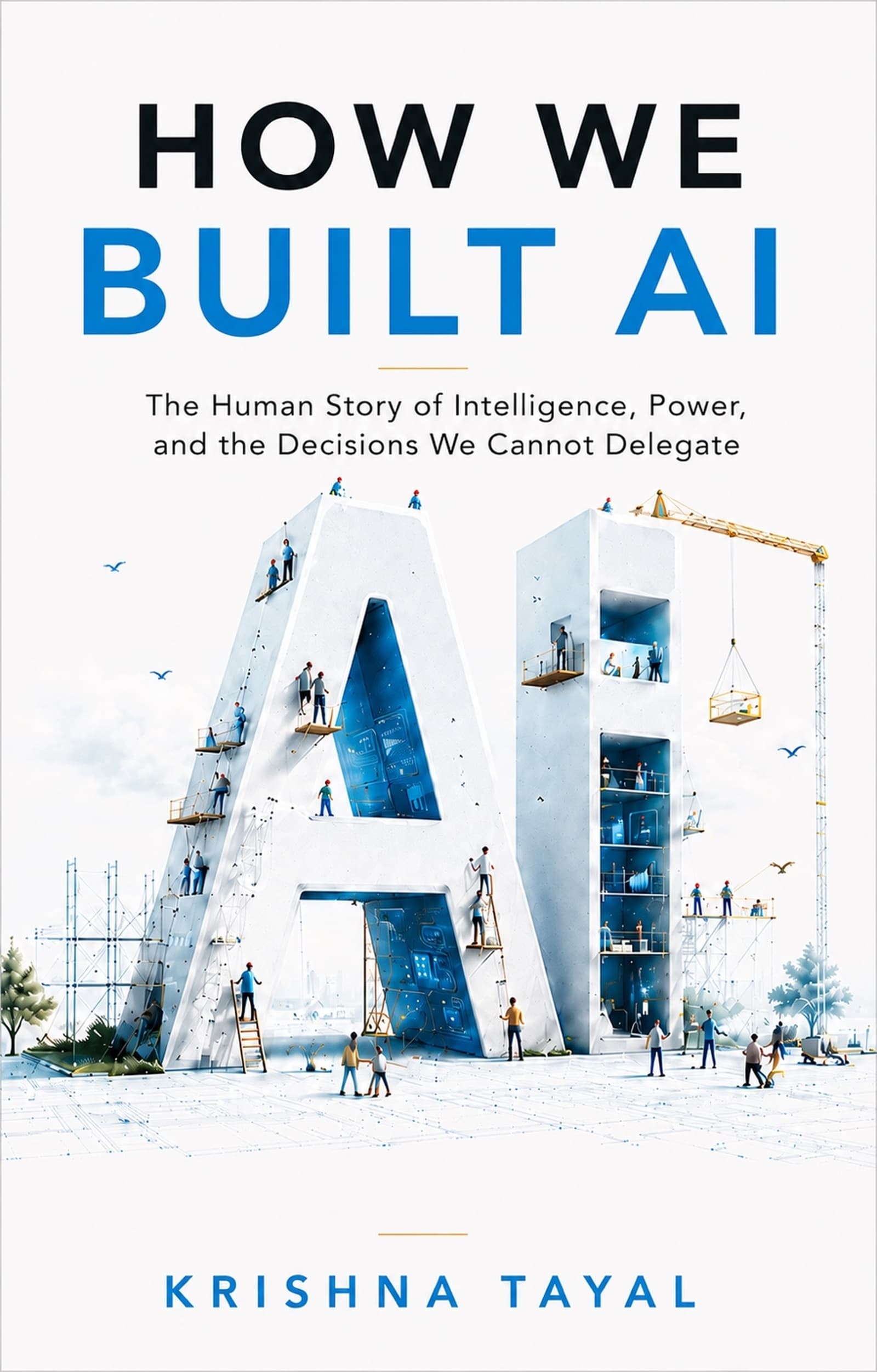
Scene / Knowledge archiveThe Human Story of Intelligence, Power, and the Decisions We Cannot Delegate
The central argument
A global history of artificial intelligence from early calculation and symbolic reasoning to generative models, agents, governance, and the institutions needed to protect human judgment.
Use the machine. Question the answer. Protect human judgment.
Available now on Amazon worldwide.
Five claims
The book moves beyond model releases to examine abundance, judgment, trust, concentrated power, and the different futures AI will create around the world.
AI lowers the cost of explanation, drafting, analysis, design, translation, and technical assistance—making output abundant before quality, purpose, and responsibility necessarily improve.
When answers become cheap, choosing the right problem, testing evidence, understanding context, rejecting convenient conclusions, and accepting responsibility become more valuable.
Capability can improve faster than confidence should. An AI system may become impressive before it becomes dependable enough for people or institutions to trust.
AI gives individuals capabilities that once required teams. That expands opportunity while enabling institutional-scale influence without institutional-scale controls.
Languages, laws, infrastructures, labor markets, cultures, and political systems will produce different AI futures that must remain compatible with dignity, correction, accountability, and meaningful human choice.
The reading journey
Symbols, rules, machines, and the earliest human arguments about the nature of thought.
How data, probability, faster computers, and learning from patterns brought AI back after its winters.
Deep learning becomes industrial infrastructure through compute, platforms, institutions, and global competition.
Language becomes an interface to models that can produce text, images, code, audio, and video.
Multimodal systems, reasoning models, agents, open models, science, regulation, and the reliability gap.
Work, education, business, misinformation, privacy, law, AGI, and how young people can prepare.
Ownership, hidden costs, inequality, evidence, authority, timelines, and decisions machines should not make alone.
Evaluation, security, creative rights, sovereignty, public infrastructure, verification, and accountable automation.
Machine authority, meaningful human review, and what a good AI society should feel like.
Who this book is for
Written for readers who want to understand AI without being buried under technical language. No calculus or coding experience is required.
Read AI as a record of ambition, labor, institutions, failure, creativity, competition, and responsibility—not a parade of models.
A confident answer is not proof. Verification is now a basic civic and professional skill.
Every model sits inside money, compute, energy, data, labor, law, competition, and culture.
Different societies carry different strengths and risks; global coverage should reveal those differences.
AI can help people move faster. Speed is useful; responsibility remains human.
Beyond the narrative
The closing material turns the history into tools readers can use to inspect a claim, evaluate a system, prepare a team, and decide when automation should stop.
Milestones That Built AI
How AI Actually Works
How AI Is Built Step by Step
AI System Types
30-Day AI Readiness Plan
How to Check an AI Claim
AI Companionship and Mental Health
Common Myths About AI
AI Decision Checklist
Four Plausible AI Futures
AI Judgment Operating System
Reader’s Final Test
Casebook: Twelve Situations That Explain the AI Age
Global AI Capability Audit
Evidence & accountability
Historical claims draw on primary papers, archives, biographies, and established histories. Technical explanations preserve the important mechanism and limitation. Frontier claims use official documentation, research papers, regulators, and institutional reports available through June 2026.
AI assisted research, comparison, drafting, language revision, and production checks under author direction. It was not treated as an authority. Krishna accepts responsibility for the final text, interpretation, and errors.
Digital edition
The English-language EPUB is built as a reflowable, navigable edition with a linked index and a reading order that works beyond one fixed screen size.
A global story, written from India
Krishna writes from Greater Noida about a technology arriving through different languages, laws, costs, public infrastructures, and institutional capacities. The book asks whether those futures will widen old inequalities or expand capability without surrendering rights, agency, and judgment.
For interviews, reviews, publication enquiries, or conversations about the ideas in the book, contact the author directly. For readers, the fastest path is Amazon or Goodreads.