01 · Challenge
Academic support often arrives after performance has already declined, while opaque risk scores can stigmatize students and weaken trust.
Explainable early warning · Human intervention
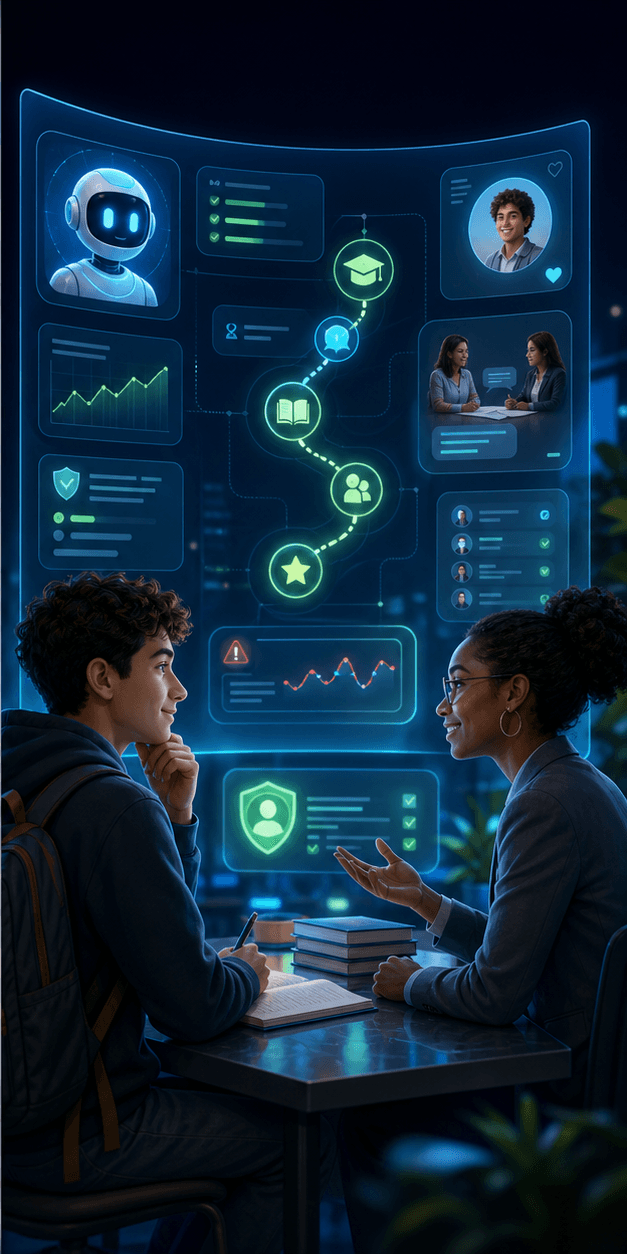
A capstone prototype with student, mentor, and advisor views designed around explainable support signals and human-led intervention rather than opaque automated decisions.
Case study brief
01 · Challenge
Academic support often arrives after performance has already declined, while opaque risk scores can stigmatize students and weaken trust.
02 · Response
I designed SuccessAI as an explainable early-support concept that combines signals, study planning, AI mentoring, and advisor action without automating the final intervention decision.
System anatomy
The architecture is expressed as responsibilities and boundaries so the model, workflow logic, interfaces, and human controls remain inspectable.
Student activity and academic context produce explainable support signals
Personalized planning and AI mentoring propose next steps
Mentor and advisor workflows keep interventions accountable and human-led
Implementation
Mapped student, mentor, and advisor journeys.
Designed explainable signals that show why support may be useful.
Created personalized planning and mentoring views with human escalation.
Documented ethical risks, evaluation needs, and a staged implementation roadmap.
Evidence & validation
Six prototype views.
Ten-slide capstone presentation and evidence PDF.
Ethics roadmap, project screenshot, and LinkedIn publication.
Reflection
In education, the system should create an earlier opportunity for support—not label a student or replace professional judgment.
Next iteration
Outcomes
Six prototype views across student and advisor journeys
Ten-slide capstone presentation and evidence PDF
Ethics, evaluation, and human-intervention roadmap
Technology & concepts