01 · Challenge
Support teams lose time when requests arrive through disconnected channels, duplicate tickets are created, priority decisions vary between agents, and SLA risk is discovered too late.
Capstone 2 · Five n8n workflows · 25 nodes
A modular n8n capstone that receives support tickets, prevents duplicates, classifies intent and urgency, routes work by skill and priority, communicates with customers, escalates risk, and measures SLA performance.
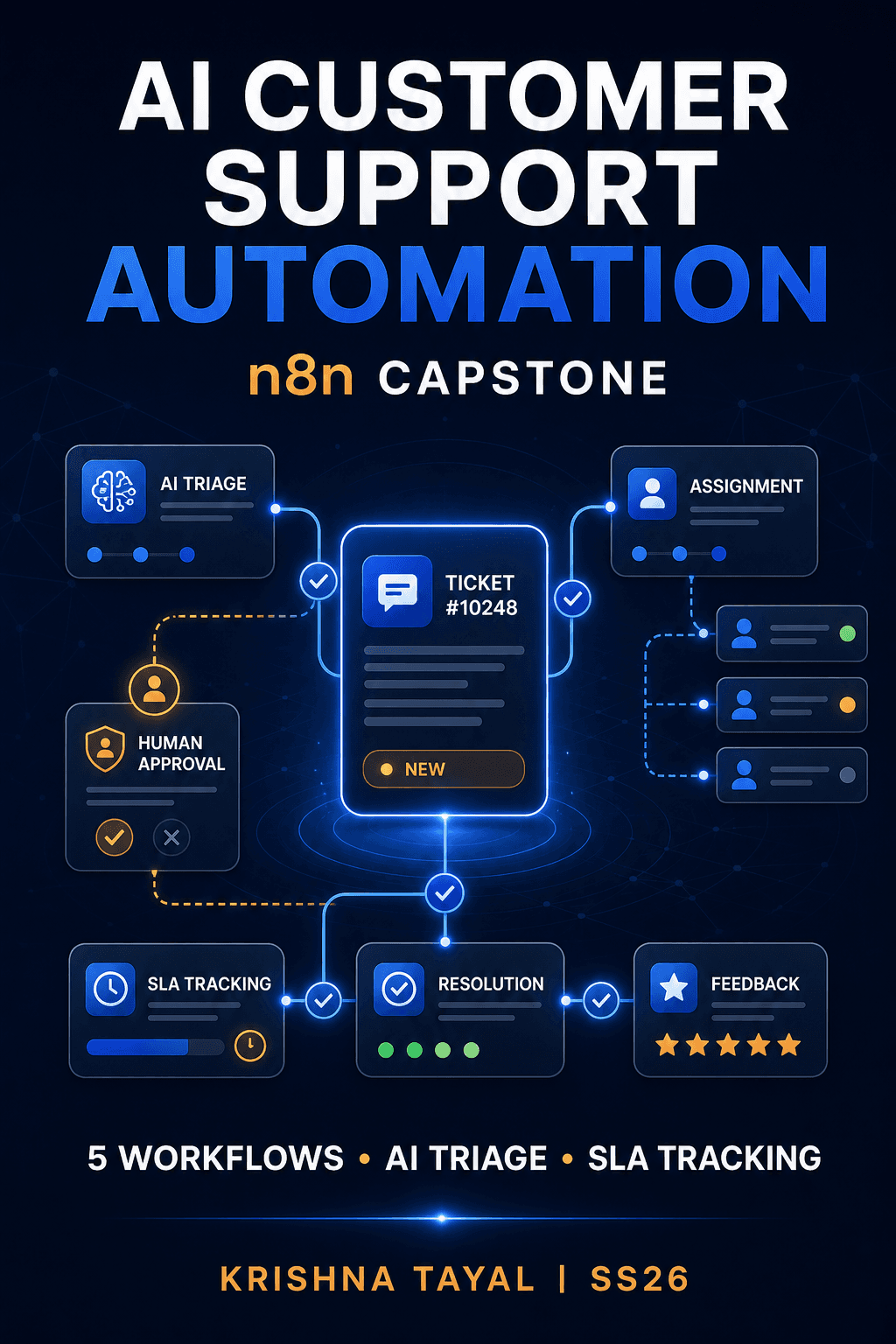
Case study brief
01 · Challenge
Support teams lose time when requests arrive through disconnected channels, duplicate tickets are created, priority decisions vary between agents, and SLA risk is discovered too late.
02 · Response
I designed a modular support-operations system in n8n. Five workflows divide intake, AI classification, assignment, communication, and analytics into independently reviewable responsibilities while sharing a consistent ticket contract.
System anatomy
The architecture is expressed as responsibilities and boundaries so the model, workflow logic, interfaces, and human controls remain inspectable.
Ticket intake, validation, identity, and duplicate prevention
AI triage followed by deterministic priority and skill-based assignment
Customer notifications, escalation, persistence, and SLA analytics across five workflows
Implementation
Normalized webhook input and generated a 24-hour duplicate fingerprint before creating a ticket.
Requested schema-constrained category, priority, sentiment, confidence, and summary fields from the model, with deterministic fallback behavior.
Combined skill fit, workload, confidence, and business risk to route work or create a manager-review event.
Persisted operational data in PostgreSQL and produced scheduled SLA/KPI snapshots for review and archiving.
Evidence & validation
Five importable workflow exports containing 25 nodes.
Database schema, diagrams, integration guide, presentation, narrated demo, and repository documentation.
Local dashboard/API demonstration plus credential-safe public packaging.
Reflection
The most reliable design kept model judgment inside a narrow classification boundary and left identity, duplication, routing rules, persistence, and escalation controls deterministic.
Next iteration
Outcomes
Five coordinated workflows containing 25 nodes
Database schema, diagrams, presentation, demo video, tests, and Docker instructions
Public repository and submission-ready evidence package
Technology & concepts