01 · Challenge
Customer-success reviews often depend on subjective judgment, fragmented account context, and manual follow-up, while fully autonomous agents can create unacceptable operational risk.
Capstone 3 · Six agents · Eight tools
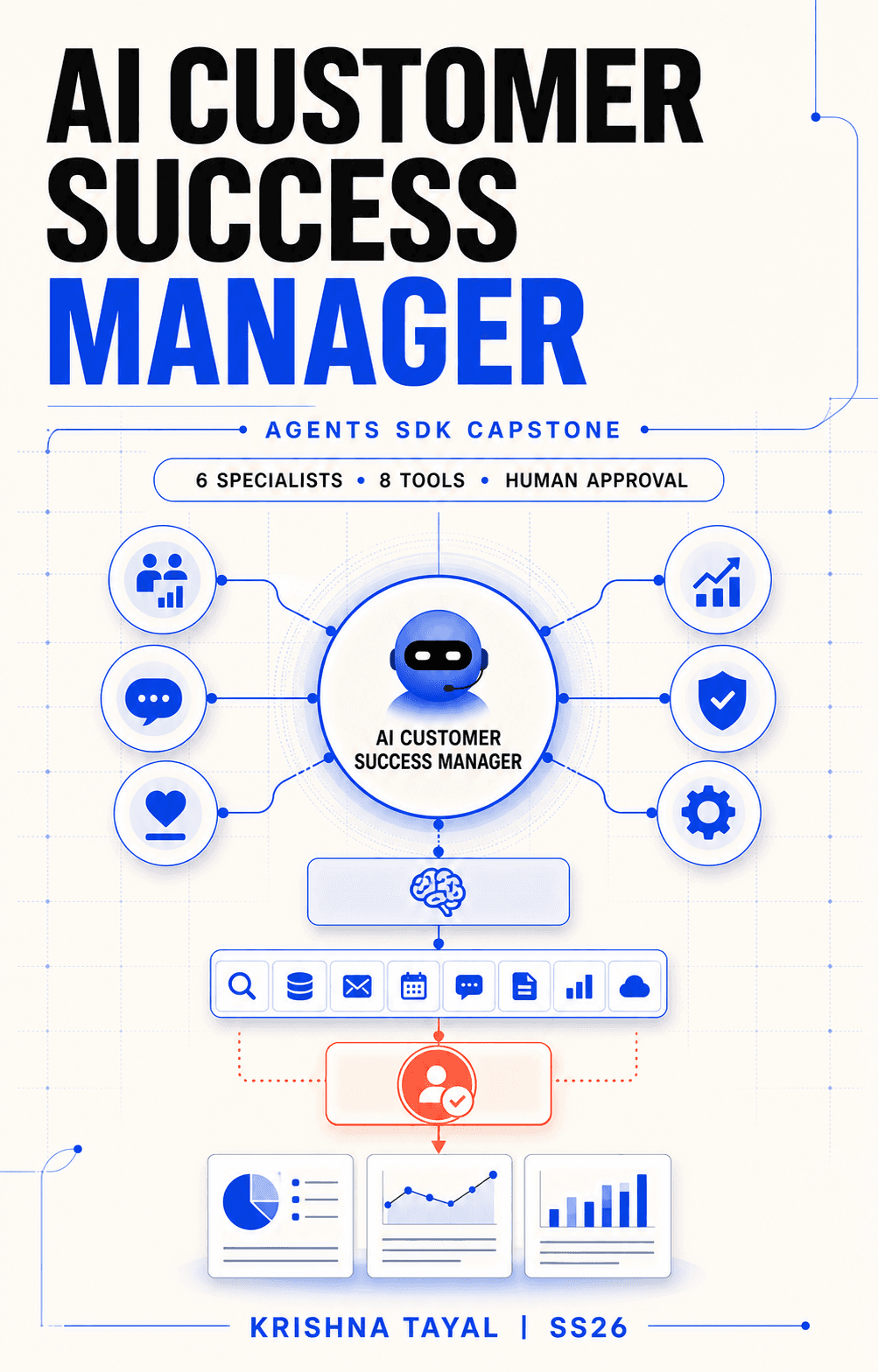
A Python Agents SDK capstone that coordinates six specialist agents and eight tools to assess account health, detect churn risk, recommend interventions, retain session context, and pause consequential actions for human approval.
Case study brief
01 · Challenge
Customer-success reviews often depend on subjective judgment, fragmented account context, and manual follow-up, while fully autonomous agents can create unacceptable operational risk.
02 · Response
I built a multi-agent customer-success system that calculates account health deterministically, delegates analysis to specialist agents, remembers the session, and pauses consequential actions for approval.
System anatomy
The architecture is expressed as responsibilities and boundaries so the model, workflow logic, interfaces, and human controls remain inspectable.
Deterministic health-score calculation from account activity, adoption, sentiment, and support signals
Six role-specific agents coordinate analysis, planning, communication, and escalation
SQLite session memory and approval-gated side effects preserve context and human control
Implementation
Created six specialists for health, product, support, escalation, planning, and analytics responsibilities.
Exposed eight tools for profile, usage, support history, product knowledge, scoring, planning, scheduling, and escalation.
Implemented both manager-as-tools and handoff orchestration patterns with Pydantic-validated outputs.
Used SQLite session memory and approval-gated side effects to preserve context without surrendering human control.
Evidence & validation
Four passing unit tests for deterministic scoring behavior.
Online and offline demonstration paths with JSON and Markdown reports.
Architecture, implementation, validation report, deck, narrated demo, and public repository.
Reflection
Agents were most useful as explainers and planners around a transparent scoring core. Deterministic numbers, structured outputs, and explicit approval made the system easier to trust and test.
Next iteration
Outcomes
Six specialist agents and eight callable tools
Tested online and safe offline demonstrations
Architecture, implementation, validation report, deck, demo video, and public repository
Technology & concepts